
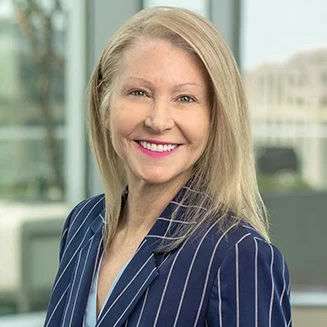
Deborah Curtis, former CIA Deputy General Counsel for Litigation and Investigations, is a partner in Arnold & Porter’s White Collar Defense and Investigations practice. Her experience spans a wide range of senior level positions in the federal government involving sensitive intelligence, law enforcement and policy issues.
At CIA, Deborah oversaw the Agency’s response to litigation, congressional investigations, critical incidents and criminal matters. In this role, Deborah advised the CIA’s Director and Deputy Director, the Office of Congressional Affairs, the Counterintelligence Mission Center and the Office of Security. She also handled several major national security policy initiatives including representing CIA interests during the U.S.-EU negotiations to reach a transatlantic data privacy agreement and the provision of U.S. information in support of Russian war crimes prosecutions before the International Criminal Court.
Prior to joining CIA, Deborah was the Chief Counsel for Industry and Security at the Commerce Department, the senior-most legal official on all licensing and enforcement decisions involving the Entity List, Military End-User List, Denied Persons List, Unverified List and other issues arising under the Export Administration Regulations. During her time at Commerce, Deborah also co-drafted the Huawei Foreign Direct Product Rule and advised on the CFIUS-adjacent process prohibiting certain foreign transactions that could impact the U.S. Information and Communications Technology and Services supply chain.
Deborah previously served for more than a decade at the Department of Justice, including at the National Security Division’s Counterespionage Section. At Main Justice, she oversaw Espionage Act cases and criminal export control and sanctions investigations and prosecutions nationwide. Deborah was also a Deputy Chief for National Security at the U.S. Attorney’s Office for the District of Columbia, where she investigated, prosecuted and supervised cases involving espionage, illegal foreign agents, state-sponsored malicious cyber intrusions and matters involving the ITAR, FCPA and theft of trade secrets.
Finally, as an Associate General Counsel for National Security and Military Affairs at the Pentagon, Deborah provided legal guidance on Air Force Special Access Programs involving air and space system projects, the issuance of national interest determinations, commercial facilities physical security breaches and counterintelligence “insider threat” probes.
Deborah Curtis, former CIA Deputy General Counsel for Litigation and Investigations, is a partner in Arnold & Porter’s White Collar Defense and Investigations practice. Her experience spans a wide range of senior level positions in the federal government involving sensitive intelligence, law enforcement and policy issues.
At CIA, Deborah oversaw the Agency’s response to litigation, congressional investigations, critical incidents and criminal matters. In this role, Deborah advised the CIA’s Director and Deputy Director, the Office of Congressional Affairs, the Counterintelligence Mission Center and the Office of Security. She also handled several major national security policy initiatives including representing CIA interests during the U.S.-EU negotiations to reach a transatlantic data privacy agreement and the provision of U.S. information in support of Russian war crimes prosecutions before the International Criminal Court.
Prior to joining CIA, Deborah was the Chief Counsel for Industry and Security at the Commerce Department, the senior-most legal official on all licensing and enforcement decisions involving the Entity List, Military End-User List, Denied Persons List, Unverified List and other issues arising under the Export Administration Regulations. During her time at Commerce, Deborah also co-drafted the Huawei Foreign Direct Product Rule and advised on the CFIUS-adjacent process prohibiting certain foreign transactions that could impact the U.S. Information and Communications Technology and Services supply chain.
Deborah previously served for more than a decade at the Department of Justice, including at the National Security Division’s Counterespionage Section. At Main Justice, she oversaw Espionage Act cases and criminal export control and sanctions investigations and prosecutions nationwide. Deborah was also a Deputy Chief for National Security at the U.S. Attorney’s Office for the District of Columbia, where she investigated, prosecuted and supervised cases involving espionage, illegal foreign agents, state-sponsored malicious cyber intrusions and matters involving the ITAR, FCPA and theft of trade secrets.
Finally, as an Associate General Counsel for National Security and Military Affairs at the Pentagon, Deborah provided legal guidance on Air Force Special Access Programs involving air and space system projects, the issuance of national interest determinations, commercial facilities physical security breaches and counterintelligence “insider threat” probes.
Rosa Brooks holds the Scott K. Ginsburg Chair in Law and Policy at Georgetown University Law Center, where she has served as a tenured professor since 2006. She also serves as Georgetown Law’s Associate Dean for Centers and Institutes and as co-director of Georgetown’s Center on Innovations in Public Safety. Brooks is also an Adjunct Senior Scholar at West Point’s Modern War Institute, an ASU Future of War Senior Fellow at New America, and HFX Fellow with the Halifax International Security Forum and a founder of the Leadership Council for Women in National Security (LCWINS).
From April 2016 to November 2020, she served as a reserve police officer with the Washington, DC Metropolitan Police Department. In 2019, she received the Chief of Police Special Award. Brooks has combined law teaching and scholarship with stints in government service and a career in journalism. From 2009-2011, Brooks served as Counselor to Undersecretary of Defense for Policy Michele Flournoy. In July 2011, she received the Secretary of Defense Medal for Outstanding Public Service. She previously served as Senior Advisor to the Assistant Secretary of State for Democracy, Human Rights and Labor.
Dr. Rebecca Bill Chavez is president and CEO of the Inter-American Dialogue. She is formerly a senior fellow in the Dialogue’s Rule of Law Program. She is a member of the Truman Center for National Policy Board of Directors, the Leadership Council for Women in National Security (LCWINS) Steering Committee, the Princeton University Institute for Regional and International Studies Advisory Board, and the Foreign Policy for America Advisory Board.
Dr. Chavez served as Deputy Assistant Secretary of Defense for Western Hemisphere Affairs from 2013 until 2016 where she prioritized Women, Peace, and Security initiatives, combatting the militarization of law enforcement, and expanding defense institution building programs. Her areas of focus included shaping Defense Department contributions to President Obama’s Central America Strategy, moving the U.S.- Mexico relationship beyond the narrow counternarcotics focus, supporting the Colombian peace process, resetting defense relations with Argentina and Brazil, and establishing a productive dialogue with Cuba on humanitarian assistance and disaster response.
AT Johnston currently serves as a Professional Staff Member on the House Energy & Commerce Committee. She is an experienced senior government official with twenty-five plus years of service. As an inclusive, mission-driven leader, Johnston demonstrates a heart for supporting people and organizations in service to others and she is passionate about growing the next generation of leaders.
As a senior leader at the Pentagon, Johnston served as the Acting Assistant Secretary of Defense for Legislative Affairs (OSDLA) where she advised the Secretary and Deputy Secretary of Defense on legislative strategy and developed and executed the congressional engagement strategy. She managed the DOD legislative interface as part of the whole of government response to the COVID 19 pandemic, during a time of civil unrest and transition.
Johnston previouslyas the Deputy Assistant Secretary of Defense for Military Community and Family Policy (MC&FP) where she embraced the concept that “if the family is not ready, the service member can not be ready and that is a threat to national security.” She oversaw increased participation in the Military Spouse Employment Partnership Program, setting the goal of reaching 500 participants by 2020. During her tenure, MC&FP established an MOU with LinkedIn allowing for military spouses to have free access to LinkedIn premium each time the service member has a permanent change of station. And, as Special Assistant to the President, Johnston served as the Principal Liaison and advocate for the President of the United States on key Administration policies.
AT and her husband Murray live in Alexandria, Virginia and they have 2 grown children.
Leah Nodvin is the Director of Government and External Affairs at the BMW Group, where she supports U.S. – European relations and covers the federal sustainability portfolio. Previously, Leah served as the Chief of Staff for the Bureau of Europe and Eurasia at USAID. Prior to joining USAID, she worked on Capitol Hill and most recently served as the Staff Director for the House Foreign Affairs Subcommittee for Europe, working on behalf of Congressman Bill Keating of Massachusetts. During her time on Capitol Hill, Leah also served as a Professional Staff Member on the House Foreign Affairs Subcommittee for Europe as well as a Foreign Affairs Legislative Assistant for a Senior Member of the House Foreign Affairs Committee.
Prior to her time in Washington, Leah completed a research Fellowship with the Parliamentary Assembly of the Organization for Security and Cooperation in Europe in Vienna, Austria. Leah holds a bachelor’s degree from Boston University as well as master’s degrees from the University College’s London School of Slavonic and East European Studies and the Higher School of Economics in Moscow. Leah is currently completing a master’s degree in Defense and Strategic Studies at the Naval War College. Leah grew up in New Hampshire and speaks basic French, intermediate Russian, fluent German and is a native English speaker.
Ambassador Laura S. H. Holgate served most recently as the U.S. Ambassador to the United Nations International Organizations in Vienna and the Representative of the United States of America to the International Atomic Energy Agency.
As an experienced national security leader, Holgate’s public service includes the reduction of threats and management of risks from nuclear, biological, chemical, and radiological weapons. She previously served as Vice President at the Nuclear Threat Initiative, Special Assistant to the President at the National Security Council, and as a senior official at the Departments of Energy and Defense. She is frequently quoted and published in print and tv and she speaks publicly on nuclear energy, nuclear security, chemical weapons, bioterrorism, and related international organizations.
Holgate received a Bachelor of Arts Degree in politics from Princeton University and a Master of Science Degree in political science from the Massachusetts Institute of Technology. She lives in Arlington, Virginia.
Dr. Kimberly A. McClain is a global strategist, retired U.S. Air Force Reserve officer, and CEO of TMG Strategic Advisors, LLC, a boutique firm advising governments, corporations, and investors on geopolitical risk, public-private partnerships, and enterprise resilience. With more than three decades of service across the U.S. military, federal government, and private sector, she is recognized for bringing clarity and precision to high-stakes decisions.
A Senate-confirmed Assistant Secretary at the U.S. Department of Housing and Urban Development (HUD), Dr. McClain led enterprise-wide strategy for a $79B federal budget, supported $1T in grants and $6T in securities, and secured $400M in reinvestments for underserved programs. At the U.S. Department of Veterans Affairs, she coauthored breakthrough legislation that delivered long-term health benefits to over 5M veterans. Earlier, as an Air Force executive, she directed policy and engagement for a $179B enterprise, improving operational performance and strengthening congressional relationships.
Her distinguished military career spanned 30 years, including senior advisory roles for the Chairman of the Joint Chiefs of Staff, where she negotiated $2B in international defense partnerships and built enduring coalitions across 45+ countries. She also pioneered the first regional cybersecurity cooperation strategy for Latin America under U.S. Cyber Command.
Nisha Biswal brings over 30 years of experience in U.S. foreign policy and international economic development including in the Executive Branch, in Congress and the private sector. Most recently, she served as Deputy CEO of the U.S. International Development Finance Corporation (DFC), overseeing operations, management and policy coordination, and helping DFC become the largest bilateral development finance institution in the world. Biswal was senior vice president for international strategy and global initiatives at the U.S. Chamber of Commerce from 2017-2023 and led the South Asia practice.
Her prior government service includes Assistant Secretary for South and Central Asian Affairs at the U.S. Department of State from 2013 to 2017. There she oversaw the U.S.-India strategic partnership, including the launch of an annual U.S.-India Strategic and Commercial Dialogue. She also initiated the C5+1 Dialogue with Central Asia and the US-Bangladesh Partnership Dialogue during her tenure as Assistant Secretary. Prior to that, Biswal was assistant administrator for Asia at the U.S. Agency for International Development (USAID),having previously worked in the Office of Foreign Disaster Assistance and the Bureau for Humanitarian Response. She also spent over a decade on Capitol Hill, working as staff director on the State and Foreign Operations Subcommittee on Appropriations as well as professional staff on the Foreign Affairs Committee in the House of Representatives.
Dr. Richard Verma is chief administrative officer for Mastercard, overseeing the company’s Law, Government Affairs and Policy, Franchise, Corporate Security, and Community and Belonging functions. He is also a member of the company’s Executive Leadership Team and Management Committee.
Rich has a distinguished background as a public servant. Most recently, he was deputy secretary of state for management and resources from 2023 to 2025. Rich acted as chief operating officer of the State Department, leading its efforts on modernization, foreign assistance and a wide range of strategic issues. He also previously served as the U.S. ambassador to India, where he led one of the largest U.S. diplomatic missions and championed historic progress in bilateral ties. He is a former assistant secretary of state for Legislative Affairs and national security advisor to the Senate Majority Leader. Rich has been a member of the President’s Intelligence Advisory Board, the Weapons of Mass Destruction and Terrorism Commission, and the Secretary of State’s Foreign Affairs Policy Board.
Rich also has extensive experience in the private sector. Prior to his most recent State Department tenure, Rich was chief legal officer and head of global public policy at Mastercard. He is a former partner at the law firm of Steptoe & Johnson and the vice chairman of The Asia Group, a global consulting firm. He also served on the T. Rowe Price corporate board of directors.
Rich is a veteran of the U.S. Air Force and the recipient of numerous military awards and civilian decorations, including the Meritorious Service Medal, the State Department’s Distinguished Service Award, and the Council on Foreign Relations International Affairs Fellowship. He is a board member of the Ford Foundation, and has previously served on the boards for Lehigh University and the National Endowment for Democracy. He is the inaugural President’s Distinguished Fellow at Lehigh and was a senior fellow at Harvard University’s Belfer Center for Science and International Affairs.
Emily Perkins is a senior leader of policy-focused non-profit organizations. Her 20-year career spans international program management, fundraising, and external relations.
Perkins served most recently as Vice President of Development at the Joint Center for Political and Economic Studies where she helped “America’s Black think tank” create a multi-year development strategy and establish operational best practices across the organization. She previously spent eight years at the Brookings Institution where she led fundraising strategy and operations for teams whose issues ranged from foreign policy to domestic political institutions. She has also held program management and business development roles in the private sector.
Perkins earned a B.A. in Political Science from Boston College and an LL.M. from the University of Kent’s Brussels School of International Studies.
Dr. Van Winkle currently serves as the Industry Executive for Federal Government at Oracle, where she supports federal agencies in using innovative technology to solve complex challenges.
Prior to joining Oracle, Dr. Van Winkle served as Director of Strategic Analytics within Raytheon Intelligence and Space. She was previously a member of the Senior Executive Service within the Department of Defense and served in multiple leadership roles across the Department focused on assessing and ensuring the readiness of the military force. Most recently she served as the Deputy Director of Military Force Management for the U.S. Air Force, establishing and overseeing military force management policies to guide the readiness and retention of the Air Force’s human capital. Prior to that role, Dr. Van Winkle served as the Executive Director of the Office of Force Resiliency and was the principal staff advisor to the Secretary of Defense on policies related to the response and prevention of interpersonal violence; developing the Department’s first integrated prevention policies and framework, for which she received the Secretary of Defense Medal for Meritorious Civilian Service.
Uyen (pronounced “Win”) Dinh serves as the Vice President of Government Relations and Strategy at BlackSky Global, LLC, a provider of real-time geospatial intelligence.
Previously, Uyen served as the Deputy Assistant Secretary for Legislative Affairs at the Department of Homeland Security. With over two decades of experience in national security and intelligence community programs and policies, the Congressional legislative process, and the executive branch planning and decision making process, Uyen’s unique skill set leverages her federal government experience with private sector insights.
In the business sector, Uyen led her own strategic consulting company, WinStrategies, LLC; after having served as Vice President for Government Relations for GeoEye, Inc. a New Space company. Her background includes national and military intelligence, space- based ISR, satellite payloads, space launch systems, GEOINT, cybersecurity, and homeland security issues such as emergency preparedness and disaster relief, customs and border enforcement, maritime security, combating human trafficking, transportation security, and humanitarian issues.
Soladé Rowe is Partner at the leading talent advisory firm, DHR Global where he advises government and nonprofit clients on executive recruitment, performance management, and leadership coaching. Prior to executive search, Soladé held several HR management roles within the retail, life sciences, management consulting, and investment banking industries. In his last corporate position, he held talent acquisition and performance management responsibilities, where he played a vital role in the company’s merger integration and supported the expansion of its e-commerce business. Soladé started his career in higher education and has served as a Trustee for his alma mater for over 20 years and serves as Chair of the Compensation Committee.
A first-generation American from Sierra Leone, Soladé holds a Bachelor of Science in International Business from Utica University and a Master of Science in Organizational Change Management from The New School for Social Research in New York City. He is also certified in Hogan Leadership Assessments. A native New Yorker, Soladé resides in Washington, D.C. with his wife and two sons.
During her career at senior levels on Capitol Hill and in private industry, Ann Elise Sauer acquired extensive experience in national security and government issues, including public and private policy matters, acquisition and contracting, federal budget issues, and the corporate world.
From 2013-2023, Ann was a founding Senior Partner in Inglee Sauer Market Strategies, LLC, a strategic consulting firm that specialized in providing timely, critical advice to corporations, think tanks and other non-profit organizations, and government entities. Ann and her partners worked primarily with defense and aerospace companies, providing input to their government affairs, business development and long-range planning organizations.
Prior to co-founding ISM Strategies, in 2012 Ann served as Staff Director for the Minority of the United States Senate Committee on Armed Services. She reported to Senator John McCain (R-AZ), Ranking Republican Member of the Committee, and managed the Republican staff of the committee, who were responsible for oversight of all issues in the national security arena, particularly annual defense authorization legislation.
Eileen Donahoe is the inaugural Special Envoy and Coordinator for Digital Freedom in the U.S. Department of State’s Bureau of Cyberspace and Digital Policy (CDP). Previously, she was the Executive Director of the Global Digital Policy Incubator at Stanford University’s Cyber Policy Center, where she worked to develop global digital policies that address human rights, security and governance challenges. She served as the first US Ambassador to the United Nations Human Rights Council in Geneva, during the Obama Administration. After leaving government, she was Director of Global Affairs at Human Rights Watch where she represented the organization worldwide on human rights foreign policy, with special emphasis on digital rights, cybersecurity and internet governance. Earlier in her career, she was a technology litigator at Fenwick & West in Silicon Valley.
Eileen serves as a member of Board of Directors of the National Endowment for Democracy; the World Economic Forum Council on the Future of Digital Economy; the University of Essex Advisory Board on Human Rights, Big Data and Technology; the NDI Designing for Democracy Advisory Board, and the Freedom Online Coalition Advisory Network.
Deborah Rosenblum has spent over 35 years working in the national security and defense field. Most recently, she served, from 2021 to 2025, as the Senate confirmed Assistant Secretary of Defense for Nuclear, Chemical and Biological Defense Programs as well as the Acting Deputy Under Secretary of Defense for Acquisition and Sustainment. In these roles she was responsible for all matters pertaining to acquisition; contract administration; logistics and materiel readiness; installations and environment; operational energy; chemical, biological and nuclear defense; as well as the defense industrial base.
From 2009 through 2021, she served as Executive Vice President at The Nuclear Threat Initiative, a global nonprofit focused on reducing catastrophic risks. She also advised corporate clients as a Vice President at The Cohen Group, a global consulting firm, on business opportunities in the defense and homeland security markets. Deborah is currently serving as a Senior Consultant to a range of defense companies; non-profits as well as academia.
She was educated at Middlebury College as well as Columbia University.
Virginia Blaser is a tech-driven CEO, founder, and AI inventor with over three decades of experience leading organizations and driving innovation across the public and private sectors. As the CEO and founder of Blaser Global, she advises corporations, NGOs, and governments on leadership, operational strategy, and the ethical integration of AI into diplomacy, development, and foreign affairs. A serial entrepreneur, Virginia has launched and scaled multiple startups, secured venture capital investments, and developed AI-powered tools, including a patent-pending platform that transforms images into customizable products — merging technology, design, and accessibility at scale. Before entering the private sector, Virginia served as a senior U.S. diplomat for over 30 years across three continents — including five years as acting U.S. ambassador to five countries. She managed billion-dollar budgets, navigated complex political and economic challenges, and advanced U.S. interests on the global stage. Virginia is the author of The Manager’s Workbook, described by the Foreign Service Journal as a “must-read” for aspiring and experienced leaders. She serves on several boards, including Cape BPO, the President’s Advisory Council at Pathfinder International, and the board of IRPIA, an Africa-based think tank focused on innovation, governance, and policy impact. She also sits on the advisory boards of Tilting Futures and Crisis Path, helping shape global strategies on leadership, innovation, and resilience. Her work reflects her passions: empowering women and youth, advancing innovation, and shaping the future of leadership in the age of AI.
Ms. Pamela Powers is the Defense Market Leader at Maximus. Prior to her current role, she joined KPMG in March of 2021 as a Managing Director and lead the Transformation Delivery service for KPMG’s Federal sector. In this role she helped organizations develop solutions to complex challenges by leveraging data, technology, and business process improvement while driving effective change management. She also serves in an advisory role for several other organizations including the Women Veterans Interactive Foundation, Kinometrix, the Leadership Council for Women in National Security, and the Partnership for Public Service.
Prior to this, she served as the Department of Veterans Affairs (VA) Chief of Staff when, on April 2, 2020, the President chose her to serve as Acting Deputy Secretary. In that role, Ms. Powers led enterprise modernization of the federal government’s second-largest Cabinet department with a budget of more than $218 billion and over 400,000 employees serving in VA medical centers, clinics, benefits offices, and national cemeteries across the country.
Anne Witkowsky previously served as Assistant Secretary of State for Conflict and Stabilization Operations.
Previously, Witkowsky served as the Co-Director of the Task Force on U.S. Strategy to Support Democracy and Counter Authoritarianism, a partnership of Freedom House. From 2014-2016, she served as the Deputy Assistant Secretary of Defense for Stability and Humanitarian Affairs in the Office of the Secretary of Defense (OSD), U.S. Department of Defense (DoD). She held policy responsibility for peacekeeping and stability operations; humanitarian assistance and disaster response; DoD support to the security of U.S. embassies; and international humanitarian law, rule of law and protection of human rights. Her office coordinated the DoD policy role in key Administration initiatives, such as the U.S. Ebola response, strengthening United Nations peace operations, and support to embassy security.
From 2009-2013, she served as the Deputy Coordinator for Homeland Security and Multilateral Affairs (DAS equivalent) in the Bureau of Counterterrorism (CT), U.S. Department of State, with responsibility for terrorist designations and sanctions; strengthening international transportation security; developing bilateral information sharing agreements; and building CT cooperation within multilateral organizations. In 2012-2013, she also served as the CT Bureau’s Acting Principal Deputy Coordinator.
Beverly Kirk is the Director of Washington Programs at Syracuse University. She was most recently the Executive Director of JOURNEY, a diverse, intergenerational community that connects preeminent emerging talent with women at the top. Prior to JOURNEY she was a fellow and director for outreach in the CSIS International Security Program and director of the CSIS Smart Women, Smart Power Initiative. She previously was director of the iDeas Lab, the multimedia production and design studio at CSIS. Before joining CSIS, Kirk was a journalist and worked for local and national news organizations, including NBC, NPR, and PBS. She spent much of her career focused on domestic and international politics and government. She also founded a media consulting company and has expertise in media curriculum design. She is a member of the adjunct faculty at the American University School of Communication. Kirk holds an M.A. in diplomacy and international commerce with a concentration in international politics and national security from the University of Kentucky and is a summa cum laude graduate of Western Kentucky University with degrees in history and broadcast journalism.
Lisa Franchetti is an experienced military leader, global strategist, and national security expert. She most recently served as the 33rd Chief of Naval Operations, retiring in March 2025 after nearly 40 years of dedicated service to the Nation. As the Navy’s senior military officer and a member of the Joint Chiefs of Staff, Franchetti advised the Secretary of Defense, the Secretary of the Navy, and the Chairman of the Joint Chiefs of Staff on national security matters.
Known for her visionary leadership, as CNO she developed long-term strategies to maintain the Navy as a formidable force in the future by strengthening its maritime dominance, building a culture of warfighting excellence, enhancing strategic partnerships and global alliances, and ensuring the Navy’s over 600,000 Sailors and Civilians were ready to execute the maritime service’s mission in peace, crisis, and war. She directed strategic initiatives to enhance future capabilities by investing in the expansion of the Navy’s Fleet, integrating advanced technologies such as robotic and autonomous systems, improving shipyard maintenance performance, resolving manpower and infrastructure challenges, and modernizing command and control centers.
A 1985 graduate of Northwestern’s Medill School of Journalism, Franchetti was commissioned through the NROTC program at a time when roles for women in the military were constrained by the Combat Exclusion Act and limited to non-combatant ships and aircraft in the Navy. When Congress repealed that law in 1993, she was among the first women to serve on combatants and went on to lead at every level. With nearly 20 years of at-sea experience, Franchetti commanded USS Ross, Destroyer Squadron 21, US Naval Forces in Korea, two Aircraft Carrier Strike Groups, US SIXTH Fleet, and Striking and Support Forces NATO. Ashore, as a Flag Officer she served as the Deputy Chief of Naval Operations for Force Development (N-7), the Director, Strategy, Plans and Policy on the Joint Staff (J-5), and the 42nd Vice Chief of Naval Operations.
Franchetti holds a Bachelor of Science in Journalism from Northwestern University and a Master’s Degree in Organizational Management from the University of Phoenix. She is a member of the Council of Foreign Relations, was awarded the Northwestern Alumni Medal in 2019, received the Naval War College Distinguished Graduate Award in 2024, was inducted into the Medill School of Journalism Hall of Achievement in 2024, and was awarded an honorary Doctorate of Humane Letters by Northwestern University in 2025.
Dr. Liz Sherwood-Randall is currently a Senior Fellow at the Harvard Kennedy School Belfer Center for Science and International Affairs. She has had a trailblazing career in national and homeland security, serving in key leadership roles at the White House, the Department of Energy, and the Department of Defense. Most recently, Liz worked in the West Wing from 2021-2025 as the Assistant to the President for Homeland Security and Deputy National Security Advisor. In that high stakes position, she pioneered Federal efforts to strengthen national preparedness for and resilience to emerging threats. She spearheaded Federal crisis management for a wide range of challenges including mass shootings, domestic and international terrorist attacks, extreme weather events, and critical infrastructure disruptions. She guided the development and implementation of new strategies to counter terrorism at home and around the world. She innovated policies to prevent, prepare, and respond to natural and pernicious biological risks, including mpox, avian flu, and the convergence of advances in biotechnology and artificial intelligence. She built a counter-fentanyl campaign involving Mexico, Canada, and China, and mobilized a global coalition of more than 80 partner countries to disrupt the synthetic opioid supply chain and save American lives.
During the Obama Administration, Liz served in three successive roles: Deputy Secretary of Energy (2014-2017); White House Coordinator for Defense Policy, Countering Weapons of Mass Destruction and Arms Control (2013-2014); and Senior Director for Europe on the National Security Council (2009-2013). She served in the Clinton Administration as Deputy Assistant Secretary of Defense for Russia, Ukraine, and Eurasia (1994-1996). At the beginning of her career, she served as Chief Foreign Affairs and Defense Policy Advisor to Senator Joe Biden. She has been repeatedly recognized for her leadership, including with the Secretary of Energy Exceptional Service Award, the Department of Defense Nunn-Lugar Trailblazer Award, and the Department of Defense Medal for Distinguished Public Service.
Liz has taught, conducted research, and mentored students at universities and think tanks including Harvard, Stanford, the Georgia Institute of Technology, and the Council on Foreign Relations. She has also advised national laboratories, power grid and cybersecurity startups, and energy investment funds.
Born and raised in Los Angeles, Liz graduated from Harvard College and received her doctorate in international relations as a Rhodes Scholar at Balliol College of Oxford University. She is married to Dr. Jeffrey Randall, a neurosurgeon in the California Bay Area, and they have two sons.
Nilmini Rubin is the Chief Policy Officer for Hedera, a fast and energy-efficient global blockchain platform. She co-founded Fix the System, a coalition of organizations committed to election integrity and democracy strengthening in the U.S. Previously, Nilmini headed Tetra Tech’s global team implementing energy and internet projects that resulted in millions of people gaining access to electricity for the first time. For twelve years, she served as a senior aide on both the U.S. Senate Foreign Relations Committee and the U.S. House Foreign Affairs Committee where she spearheaded the passage of legislation to provide electricity access in Africa, increase global internet access, reduce corruption through transparency, and reform U.S. foreign assistance. As a Director at the National Security Council under President George W. Bush, Nilmini helped secure agreements on non-proliferation, international health and foreign aid. Nilmini was named a Young Global Leader by the World Economic Forum and is a member of its Experts Network. She is an advisor to the Women’s Democracy Network and Energy Growth Hub, and a member of the Council on Foreign Relations, the Academy of the Global Teacher Prize and the International Mindfulness Teachers Association.
Eileen O’Connor is the senior vice president for Communications, Policy, and Advocacy, a member of the Foundation’s executive team, overseeing all government relations and strategic communications for all program priorities. Before joining the foundation, O’Connor spent her career as an attorney and award-winning journalist, serving as vice president of Yale University, Deputy Assistant Secretary of State in the Obama administration, for South and Central Asia, and White House and foreign correspondent for CNN and ABC news. As an attorney, O’Connor specialized in complex litigation, political investigations, multi-party dispute negotiations, and crisis management in the U.S., Russia, and Ukraine. In government, O’Connor was awarded several Superior Honor awards for her work in Afghanistan, where she was posted for 14 months, Pakistan and South and Central Asia, countering violent extremism and building democratic institutions, including a focus on women’s peace and security programs. As a journalist she earned the Peabody Award, the DuPont Award, multiple Overseas Press Club awards, an Emmy, Cable Ace, and National Headliner awards for her documentary, investigative, and war-zone coverage in the former Soviet Union, Africa, and the Middle East. Her documentary on Russian organized crime garnered a NY Film Festival Golden Eagle award.
Lisa Curtis is Senior Fellow and Director of the Indo-Pacific Security Program at the Center for a New American Security. She is a foreign policy and national security expert with over 20 years of service in the U.S. government, including at the NSC, CIA, State Department, and Capitol Hill. Her work has centered on U.S. policy toward the Indo-Pacific and South Asia, with a particular focus on Afghanistan, U.S.- India strategic relations, Quad (U.S., Australia, India, and Japan) cooperation, counterterrorism strategy in South and Central Asia, and China’s role in the region.
Curtis served as Deputy Assistant to the President and NSC Senior Director for South and Central Asia from 2017-2021 under three successive National Security Advisors. During her tenure at the NSC, she coordinated U.S. policy development and implementation of the South Asia Strategy approved by the President in 2017 and was the NSC representative at several rounds of the U.S.-Taliban negotiations held in 2019 and 2020. She was also a key contributor to the Indo-Pacific Strategic Framework approved by the President in 2018.
Essye Miller’s public service career spanned morethan three decades. She served most recently as Principal Deputy Chief Information Officer and Acting Defense Chief Information Officer at the Department of Defense, selected by former Secretary of Defense Jim Mattis. As a career member of the Senior Executive Service, Miller has deep expertise in information management and technology, cybersecurity, and critical satellite communications. She advises corporations on expansion into the public sector, the federal market, product portfolios, and executive strategy. Miller also serves as an advisor to the Information Security and Privacy Advisory Board, the Department of Commerce, and NGOs.
Allison Peters previously served as the Deputy Assistant Secretary of State in the Bureau of Democracy, Human Rights, and Labor at the U.S. Department of State where she oversaw the Bureau’s Office of Multilateral and Global Affairs, including its work on technology and human rights, Office of East Asian and Pacific Affairs, and Office of Policy Planning and Public Diplomacy. Previously, Ms. Peters served as the Senior Advisor to the Under Secretary for Civilian Security, Democracy, and Human Rights and the Senior Advisor to the Assistant Secretary for International Narcotics and Law Enforcement Affairs where she worked to advance rights-respecting approaches to technology and cyber policy and counter threats.
Prior to her time in government, Peters served as the Deputy Director of the National Security Program at the think tank Third Way where she regularly advised policymakers on a broad spectrum of foreign policy and national security issues. In this capacity, she helped to lead the Program’s Cyber Enforcement Initiative where her writing, research, and policy development focused on strengthening global cooperation and capacity to identify and bring to justice malicious cyber actors.
Paloma Adams-Allen is President and Chief Executive Officer of Airlink, a nonprofit organization that harnesses the power of aviation to provide humanitarian relief to communities in crisis. Prior to Airlink, she served in the Biden Administration as the United States Agency for International Development’s Chief Operating Officer and Deputy Administrator for Management and Resources. As second in command, she oversaw operations in over a 100 countries and led an ambitious internal reform agenda that modernized private sector engagement, spurred locally-led development, and slashed bureaucratic burdens on staff and partners.
Adams-Allen was the President and CEO of the Inter-American Foundation from 2017-2021, a period of transformation for the foundation marked by significant growth in its revenues, geographic reach, and partnerships. She has also served in senior roles at Winrock International and USAID’s Latin America and Caribbean Bureau, where she launched new public private partnerships outfits to mobilize funding and know-how and scale development impact. Adams-Allen, who speaks Spanish, also worked at the Organization of American States in programming and leadership roles for over a decade. She is currently the President of Brown University’s Women’s Alumni Network, and serves on the boards of the global non profit, Pact, and the French social impact organization, Livelihoods Venture.
Ms. Adams-Allen spent her childhood between rural Jamaica and the New England region of the U.S. She earned a Juris Doctorate from Georgetown University Law Center, a Bachelor of Arts in Development Studies from Brown University, and a Masters in International Affairs from Johns Hopkins University’s School of Advanced International Studies. An avid hiker and gardener, she lives in Washington, D.C. with her husband, two awesome daughters, and an energetic puppy.
Dr. Nora Bensahel is a Professor of Practice at the Johns Hopkins School of Advanced International Studies (SAIS), and a Contributing Editor and Columnist for War on the Rocks. She is also an Adjunct Research Staff Member at the Institute for Defense Analyses. Her work focuses on the future of warfare, and military strategy and operations. She is the co-author of the recently-published book Adaptation Under Fire: How Militaries Change in Wartime, and previously served on the Board of the Leadership Council for Women in National Security (LCWINS).
Before joining SAIS, Dr. Bensahel was a Distinguished Scholar in Residence at the School of International Service at American University and a Non-Resident Senior Fellow at the Atlantic Council. Prior to that, she was a senior fellow and co-director of the Responsible Defense Program at the Center for a New American Security. Her early career included over eleven years at the RAND Corporation, where she rose to the position of senior political scientist. She also spent more than a decade as an adjunct professor in the Security Studies Program at the Edmund A. Walsh School of Foreign Service, Georgetown University, where she taught graduate classes and received the Alumni Leadership Council Teaching Award.
Dr. Bensahel received her Ph.D. and M.A. degrees from the Department of Political Science at Stanford University, and her B.A. magna cum laude from Cornell University. While at Stanford, she worked as a research assistant for former Secretary of Defense William J. Perry. She previously served on the Secretary of Defense’s Reserve Forces Policy Board, and the President’s Council on Cornell Women.
Johnnie Kaberle is a Senior Vice President at WestExec Advisors, where she helps clients navigate the intersection of Congress, the Department of Defense, and the intelligence community. Prior to joining WestExec, Johnnie spent over three decades on Capitol Hill, culminating as Staff Director of the House Defense Appropriations Subcommittee and Deputy Staff Director of the full Appropriations Committee. In that role, she led bipartisan negotiations and shaped hundreds of billions in national security funding—playing a central role in advancing innovation, acquisition reform, and capability delivery to the warfighter. Today, Johnnie draws on that deep institutional experience to help clients understand how decisions are made in Washington, identify and pursue strategic opportunities, and build lasting relationships with key stakeholders. She also teaches legislative negotiation and is known for her ability to help clients “decode” complex government processes and deliver impact where it matters most.
Alex Kahan is a global strategy, operations, and policy leader with experience at the intersection of national security, government, and the private sector.
Most recently she served on the executive leadership team of the U.S. International Development Finance Corporation (DFC), the government’s investment arm that provides financing to the private sector to advance foreign policy and development goals in key sectors and global markets. As the Deputy Chief of Staff for Strategy, she led DFC’s enterprise strategic planning and consulting function, enabling DFC to grow to over 700 personnel with a $50B portfolio. Prior to DFC Ms. Kahan was the Chief of Staff for Global COVID-19 Response and Health Security at the U.S. Department of State, where she supported global pandemic response coordination and oversaw Department activities to distribute more than 700 million vaccines to 118 countries.
Mary DeRosa is a Professor from Practice at Georgetown University Law Center, where she focuses on national security law. She is Director of Georgetown’s Global Law Scholars program and Co-Director of its Center on National Security and the Law.
Previously, Ms. DeRosa served as Deputy Assistant and Deputy Counsel to the President and National Security Council Legal Adviser in the Obama Administration. She has also served at the U.S. Mission to the United Nations as Alternate Representative of the United States to the 66th Session of the UN General Assembly, an ambassador-level position. Before the Obama Administration, Ms. DeRosa was Chief Counsel for National Security for the Senate Judiciary Committee, working for the Chairman, Senator Patrick Leahy; Senior Fellow for Technology and Public Policy at the Center for Strategic and International Studies; Special Assistant to the President and National Security Council Legal Advisor, and earlier Deputy Legal Adviser, during the Clinton Administration; and Special Counsel to the General Counsel at the U.S. Department of Defense. Earlier in her career, Ms. DeRosa was a lawyer at the Arnold & Porter law firm and a law clerk to the Honorable Richard Cardamone, United States Court of Appeals for the Second Circuit.
Christine Abizaid led the United States Government’s counterterrorism enterprise while serving as the Director of the National Counterterrorism Center (NCTC) from June 2021 to July 2024. She was the eighth Senate confirmed Director and the first woman to lead NCTC, the primary U.S. intelligence organization that integrates, analyzes, and shares terrorism information.
Before joining NCTC, Abizaid was as an executive at Dell Technologies in its Global Operations organization, where she led and advised on geopolitical and strategic risk analysis; supply chain security; sustainability and transparency initiatives; compliance; and global inventory management. While in the private sector, Abizaid was aboard member for the Responsible Business Alliance; a board member at the Middle East Policy Council; and an inaugural Steering Committee Member for the Leadership Council for Women in National Security (LCWINS).
Colonel (retired) Patricia Mulcahy is an accomplished human resources leader and senior executive with a career that spans over 40 years as an Army officer and a civil servant. In her culminating assignment with the Department of the Air Force, Pat was the first Chief Human Capital Officer of the newest military service – the U.S. Space Force. She was responsible for creating the Space Force’s first comprehensive human capital strategy, including establishing core values, talent management goals, uniform design, motto, and logo, and conducting the most extensive transfer plan for military members since the Air Force was established in 1947.
Pat was commissioned into the Army from the Siena College Reserve Officer Training Corps program. She served at every level in the field of military personnel management and personnel service support including command of a company at Fort Devens and in Germany; a battalion at Fort Stewart; and a brigade in 18th Airborne Corps that deployed to Iraq, as well as key staff assignments as the G-1, 3rd Infantry Division; XO, Army G-1; and J-1, European Command. Following her retirement from the Army in 2009, Pat served as a federal civilian employee as well as a member of the Senior Executive Service in several military personnel policy positions in the Office of the Under Secretary of Defense for Personnel and Readiness including the Director of Officer and Enlisted Personnel Management. Pat also served as the Deputy Assistant Secretary of the Air Force for Force Management Integration.
Ambassador (ret) Laura Kennedy served almost four decades as a U.S. career diplomat. She spent much of her career working in or on the former Soviet Union and served multiple assignments in Geneva and Vienna on multilateral disarmament and non-proliferation (conventional, nuclear and biological) as well as a number of temporary assignments in New York, including the 2010 and 2015 NPT Review Conferences and heading the U.S. delegations to the UN Committee on Disarmament. She retired in 2013 but was recalled to service in 2014 to head the U.S. Embassy in Turkmenistan and then the U.S. Mission in Vienna where she served as the U.S. Governor on the Board of the International Atomic Energy Agency. She retired again in 2015.
Kennedy’s assignments included Deputy Assistant Secretary of State for Southern Europe, Central Asia and the Caucasus 2004-5, Ambassador to Turkmenistan 2001-3, Ambassador to the Conference on Disarmament in Geneva 2010-13 with concurrent service as U.S. Special Representative for Biological and Toxin Weapons Convention issues, Deputy Commandant of the National War College where she also taught for two years 2007-9, Charge d’Affaires in Armenia, and Deputy Political section chief in Moscow and Ankara. She is a member of the Leadership Council of Women in National Security (LCWINS) and the trilateral US-Germany-Russia Deep Cuts Commission. Kennedy has been a frequent press commentator and has lectured at various U.S. and international institutions including the Foreign Service Institute, the U.S. Army War College, the Army Command and General Staff College, universities and regional international affairs councils. She serves as an expert for the NewYork Times and Smithsonian Institution Silk Road travels to Central Asia. She has participated in a number of track two dialogues on nuclear arms control and nonproliferation and Asia. She is currently a member of the Secretary of State’s International Security Advisory Board.
After receiving her B.A. from Vassar College, Kennedy did graduate work at Stanford and American (M.A.) universities and is also a graduate of the Senior Seminar of the Department of State for which she later served as Dean.
Phyllis Wilson is a trailblazing leader, trusted advisor, and nationally recognized voice in purpose-driven leadership. As the 5th Command Chief Warrant Officer of the Army Reserve – the first woman in any component of the U.S. Army to hold the highest warrant officer position – she shaped strategy, culture, and the future of the military. Today, she is the President of the Military Women’s Memorial located at Arlington National Cemetery, which is America’s only major national memorial honoring the more than 3 million women who have defended America, from the American Revolution to today. Phyllis also serves on multiple nonprofit boards and offers her expertise as a national speaker on leadership, security, and workforce transformation.
Jamie Jones Miller is the inaugural Dean and CEO of Northeastern University’s Arlington, VA campus, blending her passion for national security and developing the next generation of leaders. She most recently served as a Senior Advisor at The Roosevelt Group, a strategic advocacy and consulting firm, where she worked with a wide range of clients in the defense, security, and intelligence sectors.
Jamie’s 16 years of government service includes roles as Principal Deputy Assistant Secretary of Defense for Legislative Affairs (SES III) and Deputy Assistant Secretary of Defense (SES II) where she advised the Secretary and Deputy Secretary of Defense on legislative strategy and managed relationships with members of Congress and key congressional staff, the military departments as well as the White House, National Security Council and federal departments and agencies in support of DoD priorities. Jamie is a 2018 graduate of National Defense University’s PINNACLE flag and general officer course and was awarded the Department of Defense Medal for Distinguished Public Service by the Secretary of Defense in 2020.
A native of Cuba, former U.S. Rep. Ileana Ros-Lehtinen (R-FL) served for almost three decades as a Member of Congress representing diverse areas in South Florida. She was the Chairwoman of the House Committee on Foreign Affairs and the Chairwoman of the Subcommittee on the Middle East and North Africa (MENA). In these roles, she led on pressing foreign policy issues, including championing the advancement of freedom and democracy for all, fighting Islamist extremism; supporting free trade agreements with Colombia, Panama, and South Korea; and imposing sanctions on human rights violators in Venezuela. Her record over nearly four decades of public service includes fighting against tyranny and oppression, particularly in her native homeland of Cuba, as well as working diligently to support and strengthen the US – Israel strategic partnership.
Rep. Ros-Lehtinen served on the House Permanent Select Committee on Intelligence and was a member of the CIA Subcommittee and the National Security Agency and Cybersecurity Subcommittee. A strong proponent of education, Rep.
Melissa G. Dalton has over 20 years of experience in U.S. defense, aerospace, and national security affairs. She served as the 28th under secretary of the Air Force. She was responsible for organizing, training, and equipping the U.S. Air Force and Space Force, overseeing an annual budget exceeding $200 billion, and accountable for the welfare of nearly 700,000 active-duty, guard, reserve, and civilian Airmen, Guardians, and their families. Ms. Dalton performed the duties of deputy under secretary of defense for policy from December 2023 to May 2024, when she served as the principal advisor to the secretary of defense on the formation of national security and defense policy. Additionally, she served as the assistant secretary of defense for homeland defense and hemispheric affairs from March 2022 to May 2024. She joined the Biden administration in January 2021 as the principal deputy assistant secretary of defense for strategy, plans, and capabilities. From 2014 to 2021, Ms. Dalton led research and analysis at the Center for Strategic and International Studies, including directing the Cooperative Defense Project and serving as deputy director and senior fellow in the International Security Program. Ms. Dalton served for more than a decade as a career civil servant in the Bush and Obama administrations within the Department of Defense. Ms. Dalton is a recipient of the Department of Defense Distinguished Public Service Medal. She was a Council on Foreign Relations International Affairs fellow and is a member of the Council on Foreign Relations. She is a Principal at WestExec Advisors, a Non-Resident Senior Advisor at the Center for Strategic and International Studies, a Board Member of the Saber Six Foundation, and is the Principal of Potomac River Strategies, LLC.
Shamila Chaudhary currently serves as the Democratic Co-Chair of the Afghanistan War Commission
Shamila N. Chaudhary is an international affairs analyst specializing in U.S. foreign policy with a focus on South Asia. She was the President of the American Pakistan Foundation; a Non-Resident Senior Fellow at the Atlantic Council’s South Asia Center; and a Senior Fellow at New America. In her personal capacity, she is a member of the Foreign Policy for America Leadership Circle and serves on the Advisory Council of South Asians for America.
Chaudhary worked for over a decade in the U.S. government, including at the White House as Director for Pakistan and Afghanistan on the National Security Council from 2010-2011. She also served in the U.S. Department of State’s Policy Planning Staff as South Asia Advisor to Secretary of State Hillary Clinton and the late Ambassador Richard Holbrooke.
Stacie Pettyjohn is a Senior Fellow and Director of the Defense Program at the Center for a New American Security (CNAS). Her areas of expertise include defense strategy, posture, force planning, the defense budget, and wargaming. Her current projects focus on munitions stockpiles, the effect of drones on warfare, and deterring the use of nuclear weapons in a multipolar world. Prior to joining CNAS, Pettyjohn spent over ten years at the RAND Corporation where she served as the Director of the Strategy and Doctrine Program in Project Air Force and the co-director of the Center for Gaming. In2020, she was a volunteer on the Biden administration’s defense transition team.
She has designed and led strategic and operational games that have assessed new operational concepts, tested the impacts of new technology, examined nuclear escalation and warfighting, and explored unclear phenomena, such as gray zone tactics and information warfare. Previously, she was a research fellow at the Brookings Institution, a peace scholar at the United States Institute of Peace, and a TAPIR fellow at the RAND Corporation.
Ambassador Nina Hachigian (ret) was the first U.S. Special Representative for City and State Diplomacy at the U.S. Department of State from 2022 to 2025 in the Biden Administration. Before that, Amb, Hachigian served as the first Deputy Mayor for International Affairs for the City of Los Angeles for five years. From 2014 to 2017, Ambassador Hachigian served as the second U.S. Ambassador to the Association of Southeast Asian Nations (ASEAN) in the Obama Administration. Earlier, she was a Senior Fellow and a Senior Vice President at the Center for American Progress focused on Asia policy and U.S.-China relations. Before that, Ambassador Hachigian was the director of the RAND Center for Asia Pacific Policy for four years.
Ambassador Hachigian served on the staff of the National Security Council in the Clinton White House from 1998-1999. She is the editor of Debating China: The U.S. – China Relationship in Ten Conversations (Oxford University Press, 2014) and co-author of The Next American Century: How the U.S. Can Thrive as Other Powers Rise (Simon & Schuster, 2008). She went to Yale University and got her JD from Stanford University.
Mary Beth Bruggeman spent eight years as an active-duty Marine combat engineer. Upon leaving active duty, Mary Beth worked for iRobot Corporation for four years, advancing their work on counter-IED robotics, spent time as a stay-at-home mom and Marine wife, and then started a fitness and nutrition coaching business.
Mary Beth joined the Mission Continues team in 2015 as the Executive Director for the Southeast Region. In 2019, Mary Beth assumed the role of President of The Mission Continues. Mary Beth has degrees from the U.S. Naval Academy (BS) and Georgetown University (MPP), and is an alum of the George W. Bush Institute’s Stand-To Veteran Leadership Program. She lives in Fairfax Station, VA, with her husband Brian, a retired Marine, and their three kids.
Ambassador Bonnie Jenkins is currently the Shapiro Visiting Professor of International Affairs at the Elliot School of International Affairs at George Washington University and the Compton Visiting Professor at the Miller Center at the University of Virginia. From 2021- 2024, she served as the Under Secretary of State for Arms Control and International Security Affairs.
As Under Secretary of State, Jenkins oversaw three bureaus: the Arms Control, Deterrence, and Stability Bureau (ADS); the International Security and Nonproliferation Bureau (ISN); and the Political-Military Affairs Bureau (PM). Notably, she was appointed by Secretary of State Antony Blinken in May 2023 to lead the Department’s implementation efforts on AUKUS, the trilateral security partnership between Australia, the United Kingdom, and the United States. Ambassador Jenkins has the distinction of being the first African American to hold the position of Under Secretary of State.
Ambassador Jenkins was a Nonresident Senior Fellow at the Brookings Institution from 2017 – 2021. She was also a Joint Visiting Fellow at The Brookings Institution and the University of Pennsylvania’s Perry World House. She continued at the University of Pennsylvania from 2018 – 2021 as a Visiting Scholar at the Nursing School and the School of Veterinary Science.
Dr. Jung H. Pak was Deputy Assistant Secretary in the Bureau of East Asian and Pacific Affairs at the U.S. Department of State. During her tenure at State, she was responsible for overseeing relations with Australia, New Zealand, and the Pacific Islands (2023-2024); deepening and expanding U.S. relationship with the Association of Southeast Asian Nations and related fora (2021-2023); and leading on Global China issues (2021-2022), developing new initiatives and strengthening collaboration with key foreign interlocutors. She concurrently served as U.S. Deputy Special Representative for North Korea from 2021-2023 and as the top U.S. official on North Korea policy from 2023-2024.
Prior to arriving at State, Dr. Pak was a senior fellow at the Brookings Institution, where she focused on Korean Peninsula issues, East Asia regional dynamics, and transnational threats related to proliferation, cybersecurity, and climate change. While at Brookings, she authored Becoming Kim Jong Un, which has been translated into multiple languages and draws from her deep knowledge and experience as an intelligence officer.
Laura Rosenberger is currently the Chair of the American Institute in Taiwan. Previously, she served as the Senior Director for China at the National Security Council.
Laura Rosenberger was the director of the Alliance for Securing Democracy and a senior fellow at The German Marshall Fund of the United States (GMF). Before she joined GMF, she was foreign policy advisor for Hillary for America, where she coordinated development of the campaign’s national security policies, messaging, and strategy. Prior to that, she served in a range of positions at the State Department and the White House’s National Security Council (NSC). As chief of staff to Deputy Secretary of State Tony Blinken and earlier as then-Deputy National Security Advisor Blinken’s senior advisor, she counseled on the full range of national security policy. In her role at the NSC, she also managed the interagency Deputies Committee, the U.S. government’s senior-level interagency decision-making forum on our country’s most pressing national security issues.
Jeannette Gaudry Haynie, PhD, is a security and conflict scholar, retired Marine Corps officer and combat veteran, and former government senior executive leader. A New Orleans native and U.S. Naval Academy graduate, she is a Cobra attack helicopter pilot by trade who has served both within and outside the government in a wide range of leadership roles. Within the government, she has served on active duty, as a reservist, and in a civilian executive leadership role at the Department of Defense; outside of government, she has served as a principal research scientist, nonprofit executive, and adjunct professor.
Dr. Haynie served on active duty as a Cobra pilot and instructor before transitioning into the reserves and beginning graduate school. While serving on the Joint Staff and in the Marine Corps Commandant’s think tank, she earned her MA in Political Science from the University of New Orleans and her PhD in International Relations from The George Washington University. She retired after 22 years of combined active and reserve service in the Marine corps.
Mariah Sixkiller is a Director at Hakluyt & Co, a strategic consulting firm based in London. She works in the San Francisco office and specializes in tech policy and regulatory matters for corporate and investor clients. Before joining Hakluyt in 2023, Mariah was the General Manager for Strategy in Microsoft’s US Department of Defense business. She also served as Director of Government Relations for Microsoft’s National Security Government Affairs team, focusing on public policy related to cloud, AI, quantum, and national security matters.
Dr. Laura Taylor-Kale is the Senior Fellow for Geoeconomics and Defense at the Council on Foreign Relations (CFR) where she conducts research on economic security and defense industrial policy and investments. She is also a Senior Research Fellow in the Blue Center for Global Strategic Assessment at the Yale Jackson School of Global Affairs.
From 2023-2025, Dr. Taylor-Kale served as the first Presidentially-Appointed, Senate-Confirmed Assistant Secretary of Defense for Industrial Base Policy. In her role, she led all defense industrial strategy, investments, and planning, including the Defense Production Act and industrial base investments, supply chain resilience, small business programs, international defense industrial cooperation, and economic security and review of domestic mergers and acquisitions and foreign investments (CFIUS). She led the Department of Defense in developing and publishing the first-ever National Defense Industrial Strategy and Implementation Plan. During her tenure, she led the expansion of strategic investments in rare earth elements, critical and strategic materials, solid rocket motors, and other upstream supply chain materials. To further accelerate investment in the Defense Industrial Base, Dr. Taylor-Kale launched the DoD’s largest other transaction contracting vehicle, the Defense Industrial Base Consortium. During her tenure, she led a record of $3.3 billion of grants to manufacturing and defense industrial supply chain businesses through the Defense Production Act and the Industrial Base Fund. Additionally, she established the first Board of Directors for the strategic and critical materials for the National Defense Stockpile.
Dr. Taylor-Kale is a policy executive, strategist, and organizational behavior scholar with extensive experience in finance, business, economic policy and managing in complex organizations. From 2021-2023, she served as the Fellow for Innovation and Economic Competitiveness at the Council on Foreign Relations (CFR) and contributed to CFR’s Renewing America Initiative. Her CFR research focused on strategic innovation, industrial policy, and the changing nature of work. From 2017-2018, she was an International Affairs Fellow at CFR and the deputy director of CFR’s independent task force on the future of the U.S. workforce, co-authoring of the task force’s published report “The Work Ahead: Machines, Skills, and U.S. Leadership in the Twenty-First Century.”
Previously, Dr. Taylor-Kale served in the Obama Administration from 2014-2017. As the Deputy Assistant Secretary of Commerce for Manufacturing in the International Trade Administration, Dr. Taylor-Kale led multiple teams of international trade specialists and oversaw policies and programs to promote exports of U.S. manufactured goods and economic competitiveness in health and information technology; energy and environmental technologies; and transportation and machinery sectors. Prior to the Department of Commerce, Dr. Taylor-Kale was the senior advisor for policy and operations at the U.S. Overseas Private Investment Corporation where she coordinated policies for OPIC’s $5 billion portfolio of investments in Asia and sub-Saharan Africa. Dr. Taylor-Kale joined the Obama Administration from the World Bank where she was special assistant to the Vice President for sustainable development and climate change.
From 2003-2012, Dr. Taylor-Kale was a career Foreign Service Officer in the U.S. Department of State and served in diplomatic postings in India as a consular officer and special assistant to the ambassador, Côte d’Ivoire as a political affairs officer, Afghanistan as an economic affairs officer, and in Washington, DC in the Bureau of Economic and Business Affairs as a financial economist. She received multiple awards for her economic analysis and from 2010-2011, was the first Foreign Service Officer to serve as an advisor to the U.S. Executive Director on the boards of the World Bank Group.
Dr. Taylor-Kale holds a B.A. in economics and anthropology from Smith College, an M.P.A. in development economic and demographic studies from Princeton University’s School of Public and International Affairs, an M.B.A. in finance and management from the New York University’s Stern School of Business, and a Ph.D. in management science and engineering with a specialization in Organizations, Technology, and Entrepreneurship from Stanford University’s School of Engineering. Her scholarly research examines grand challenges, ecosystem design, and how organizations leverage technology to build cross-sector strategic partnerships. Dr. Taylor-Kale is a life member of the Council on Foreign Relations and is the recipient of numerous educational and professional awards, including the Zhi-Xing Eisenhower Fellowship, International Career Advancement Program, Thomas R. Pickering Foreign Affairs Fellowship, and the David Boren Scholarship for Critical Language Study. She is a member of the Truman National Security Project and an alumna of the Leadership Council for Women in National Security.
A retired career diplomat from the US Department of State, Annie is a Senior Non-Resident Associate at the Center for Strategic and International Studies, an Adjunct Professor at the City University of New York, and a public commentator on foreign policy. She is a life member of the Council on Foreign Relations and active on non-profit boards relating to NewYork City and Afghanistan advocacy.
As a self-employed consultant, Annie works with non-profits and think tanks on issues relating to US policymaking and fragile states, international organized crime, Afghanistan, and Latin America.
Her thirty-year diplomatic career focused on security, rule of law, and human rights policy. She was the Acting Deputy Assistant Secretary of State for Afghanistan and Deputy Chief of Mission in Kabul; Office Director for UN Peacekeeping and Sanctions; head of the $700 million security assistance program in Mexico; the lead human rights officer in Turkey and South Africa; and a Director at the National Security Council implementing policy on Central American migration. Ms. Pforzheimer is a graduate of Harvard, with a Masters in National Security Studies from the National Defense University.

